
Regene Prıme
Orthopedic & Regenerative Center
Ортопедический и регенеративный центр
مركز تقويم وتجديد العظام
×
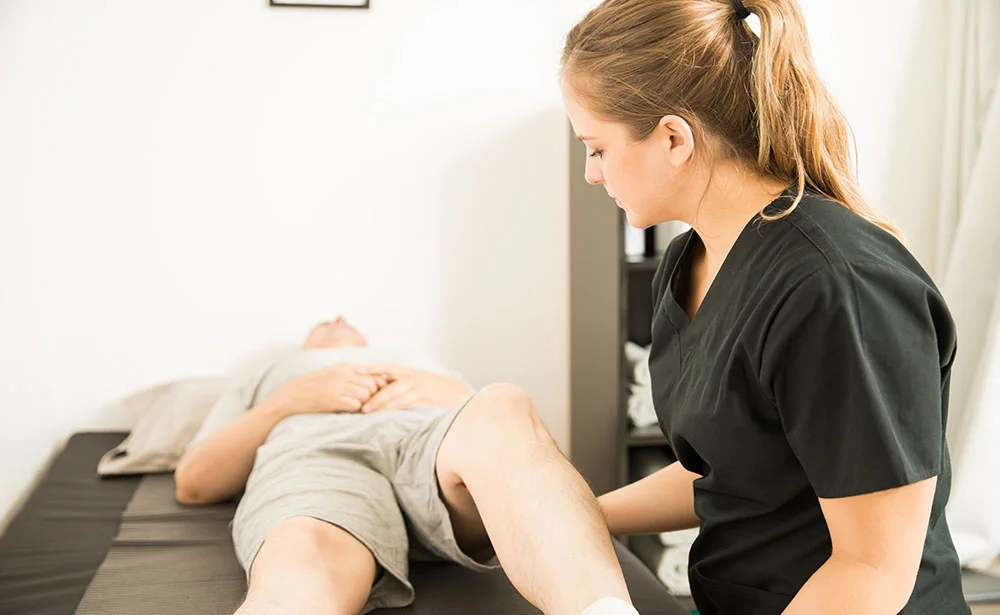
Is it bad if the knees make a noise when squatting and standing up?
Attention if you are experiencing pain in your knees!
Pain in the kneecap with crunching may indicate joint calcification!
If you experience pain with a sound coming from your knees during squatting or climbing up and down stairs, it may indicate a problem. Orthopedics and Traumatology specialist Prof. Dr. Gökhan Meriç gave important information about when this situation, which many people experience from time to time, should be taken into consideration.
There is joint fluid in the joint for the knee joint to move comfortably. During exercises such as squatting or squatting, the gas in this fluid in the knee joint can cause a sound similar to the clicking of the fingers due to the crushing of the gas in this fluid.
Orthopaedics and Traumatology Specialist Prof. Dr. Gökhan Meriç said that if there is a constant pain with every joint movement, then a condition called ‘crepitus’ may occur.
Yeditepe University Hospitals Orthopedics and Traumatology Specialist Prof. Dr. Gökhan Meriç stated that the sound coming from the knee while exercising or climbing stairs under the age of 30-35 is generally not pathological, that is, it does not indicate a problem. “However, if the patient has pain while the knee is making noise even though the patient is at a young age, or if your knees ache and creak when going up and down the stairs around the age of 55-60, this may indicate a different underlying disease,” said Dr. Meriç.
THE PROBLEM IN YOUNG PEOPLE MAY BE RELATED TO THE KNEECAP!
According to the information given by Prof. Dr. Gökhan Meriç, the sound coming from the knees with pain in young people may be caused by problems related to the kneecap. Prof. Dr. Gökhan Meriç said, “Due to the fact that the bones of the knee joint are not in the proper position in the groove formed by the bones of the knee joint, crunching in the knee and then pain may occur at an early age, especially in young women.” Prof. Dr. Gökhan Meriç continued his words as follows: “The cartilage tissue covering the knee joint actually does not feel pain. However, over time, due to repetitive friction, the protective cartilage inside the joint gradually wears out and may cause softening and then advanced cartilage wear. After advanced cartilage wear, the bone surface appears and the patient’s knees become painful.”
SEDENTARY LIFE MAY BE THE CAUSE
Stating that a sedentary life and physical activity play an important role in the emergence of the problem, Prof. Dr. Gökhan Meriç said, “A study conducted in Brazil in 2019, in which people with advanced cartilage wear in their knees were evaluated, it was revealed that those who heard a crunching sound from their knees were in lower physical activity and their quality of life was lower than those who did not hear the sound.”
PAIN WITH SOUND IS AN IMPORTANT INDICATOR
Prof. Dr. Meriç underlined that the pain seen along with the sound coming from the knee is an important sign of the presence of a different problem underneath. Prof. Dr. Meriç explained that in a study published in 2014, it was shown that the crunching seen with kneecap pain is an early sign of calcification of the kneecap joint. However, Prof. Dr. Meriç reminded that not everyone who has knee pain may experience pain and gave the following information on the subject: “In addition to this research, another study published in May 2017 and involving approximately 3,500 participants showed that people who initially had more noise from their knees but did not have pain were more likely to develop cartilage wear in their knees than those who experienced less or no crunching.”
THE PRESENCE OF PAIN ALSO SHAPES THE TREATMENT
Prof. Dr. Gökhan Meriç said that the presence or absence of pain associated with crunching is also an important criterion in terms of approaching the situation and gave the following information: “Occasional crunching without any discomfort or pain is usually nothing to worry about and it is sufficient to follow up. However, if pain is experienced with crunching, it is necessary to stay away from movements that strain the knee and consult a specialist. This condition may develop due to anatomically inappropriate congenital placement of the kneecap in young people and cartilage wear called calcification in those over 50 years of age. In this case, the cause of the problem is revealed by examination and imaging methods and the necessary treatment is applied.”
HOW TO PROTECT YOUR KNEES DURING EXERCISE?
Pointing out the importance of leg and hip strengthening exercises to reduce complaints in painless or painful crunches, Prof. Dr. Gökhan Meriç explained the following about the things to be considered while exercising:
“The aim of the exercises is to reduce the load on the knee by increasing muscle strength and to keep the kneecap in the appropriate position. Since exercises can cause knee wear and tear when not performed properly, movements that require excessive bending and lifting, such as squats, should be avoided. If there is a crunch or slight discomfort in the knee while doing the exercises, the load on the knees can be prevented by throwing the hip back instead of putting the body weight on the knee. Again, to train the hip and lateral leg muscles, walking exercises with slightly bent knees and walking sideways are very effective. Muscle tension should be prevented with stretching and stretching exercises before the exercises and maximum efficiency should be tried to be obtained from the movements. Walking and swimming are also very useful exercises for joints.”
THOSE WITH EXCESS WEIGHT SHOULD GET RID OF EXCESS WEIGHT
Pointing out that one of the most important things to be done to prevent knee pain and crunching is to reduce the load on the joints, that is, to lose weight, Yeditepe University Hospitals Orthopaedics and Traumatology Specialist Prof. Dr. Gökhan Meriç explained the other measures to be taken:
“If the patient has pain due to calcification, knee pads that can be used during intense activity can be used for a short time, especially during painful periods by supporting the joint. Especially during painful periods, climbing up and down stairs at home or outside should be avoided, housework should not be done on the knee, and prayer should be done sitting if possible during painful periods. If swelling occurs with crunching in the knee joint, this condition can usually develop due to calcification, i.e. advanced cartilage wear. In such cases, you should rest, ice can be applied to the knee, a pillow can be placed under the knee and kept above the level of the heart and a bandage can be wrapped around the knee. However, if the complaints do not go away despite these applications, a specialist should be consulted.”