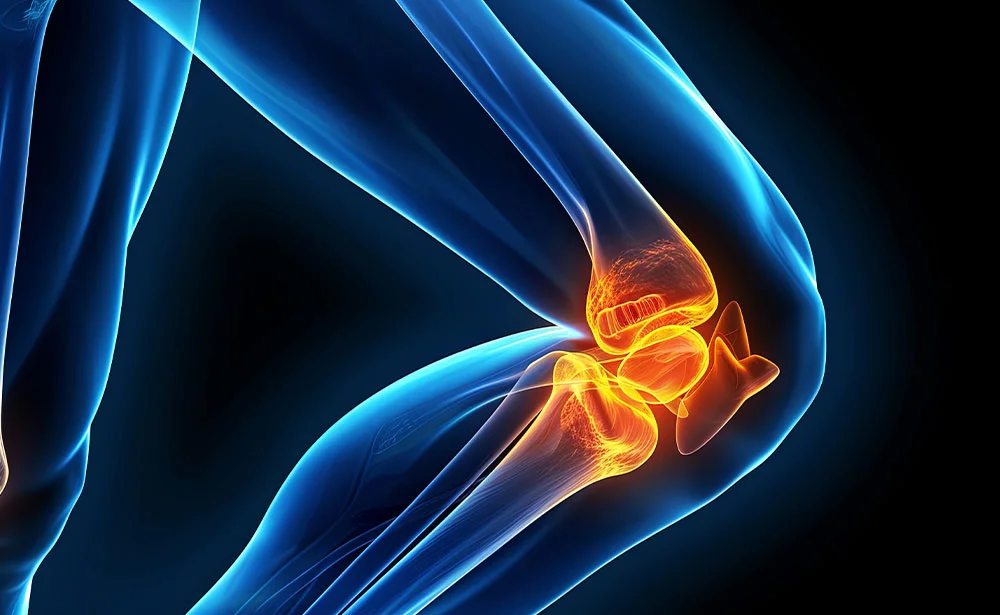
Osteoarthritis is a progressive and progressive condition characterised by pain, swelling, sound between the joints and limitation of movement in the knee joint.
In a 2020 study, cartilage damage, known as calcification, is expected to be the fourth leading cause of disability, and this situation affects the quality of life of patients over 60 years of age. Knee cartilage damage affects 19% of adults over the age of 45 and 37% of people over the age of 60. In our country, due to the increase in obesity, inactivity and aging of the population, more and more patients are admitted to hospital due to this condition.
In the treatment of arthritis, we recommend weight loss, exercise and reducing movements such as climbing and descending stairs and stairs to all our patients. Intra-articular injections are a treatment method that can be easily applied in patients with pain and is recommended for patients whose complaints persist despite pain relief and exercise.
PRP, hyaluronic acid and stem cells can be used as intra-articular injections. In a study comparing injections into the knee due to cartilage wear, it was shown that stem cells obtained from adipose tissue were more effective than PRP, bone marrow-derived stem cells and hyaluronic acid in reducing pain and increasing movement.
What is a stem cell and what does it do?
Stem cells are cells that have the capacity to transform into other cells in the body. In our body, adipose tissue, bone marrow and umbilical cord are stem cell sources. Stem cells have many cellular products that provide pain relief by reducing inflammation responsible for pain.
Who can have stem cell application?
Effective results can be obtained with stem cell therapy in patients in the early stages of cartilage wear. In patients with joint pain due to cartilage destruction and who cannot get results with painkillers or physiotherapy, it is applied in order to slow down the process of tissue damage, reduce pain and regain movement. Stem cells can also be applied in muscle tears and ligament damage in orthopaedic applications.
What are stem cell sources?
The sources of stem cells in our body are adipose tissue, bone marrow, blood and umbilical cord. However, in practice, stem cells are most commonly obtained from bone marrow and adipose tissue. The cell structure of bone marrow and umbilical fat has different characteristics. Adipose tissue contains a much higher number of stem cells than bone marrow.
How is stem cell application procedure performed?
The pelvic bone and umbilical fat are sources from which a large number of stem cells can be extracted, and samples are taken from these tissues under mild sedation and local anaesthesia without the patient being completely asleep. The samples are subjected to a separation process and the stem cells in the tissue are revealed. The prepared stem cells are injected into the damaged areas. This procedure takes approximately 20-30 minutes.
The material obtained by these methods is not a pure stem cell, but includes blood products and fluids called plasma together with stem cells. Pure stem cells can only be obtained in a laboratory environment. For pure stem cells, samples taken from the patient are obtained after 1-2 weeks of cellular reproduction, which is a much more technical process.
Do stem cells repair damaged tissue?
It is not possible to completely restore cartilage damage with stem cell application. However, in studies on cartilage healing, it has been shown that an increase in the cartilage volume of patients has been detected in MR imaging taken after stem cell application compared to the pre-application period. In cartilage damage that requires intervention, stem cells do not replace the intervention, but stem cell applications performed together with the intervention increase the success of the treatment.
What innovations can be expected in stem cell applications in the future?
Many studies are carried out on stem cell applications. Since it is a biological product, studies on controlling these cells, whether there are side effects, which type of stem cell application can be applied to which disease are ongoing. Stem cells realise their effects by sending various signals to the tissues in which they are located.
These signals are carried by small molecules called exosomes. There are also many studies on exosomes. In the future, it is aimed to obtain specific effects such as cartilage formation only by ensuring the transport of certain signals using only exosome injection.